A critical platform is out of support
CentOS or another operating system has reached end of life, but applications, runtimes and dependencies make a safe replacement more complex than an in-place upgrade.


Managed Linux hosting, migration and support
Use Think Open as a one-off project or a retained support layer.
Think Open supports Linux, cPanel, Plesk, LAMP and open-source application environments without vendor lock-in. Bring Thintech in for a focused health check, a controlled migration, hands-on recovery or specialist depth alongside your internal team.
Tell us whether you need to stabilise the current service, plan a move or add responsive Linux expertise.
I need to discuss Linux supportNew enquiries are assessed before support begins. Existing contracted customers should use their agreed service channel.
Freedom needs ownership
Think Open is for organisations whose Linux estate has become too important to rely on fragmented suppliers, unsupported platforms or undocumented knowledge.
CentOS or another operating system has reached end of life, but applications, runtimes and dependencies make a safe replacement more complex than an in-place upgrade.
Operational history, privileged access and application context sit with one specialist whose availability has become a business risk.
The hosting provider supplies a VM, the developer owns the application and nobody coordinates the operating system, network, backup and incident path.
Signals exist, but the organisation still has to decide who investigates, who can change the platform and who coordinates the response.
Jobs may show as successful while restore ownership, application validation, recovery priorities and testing remain unclear.
Legacy PHP, databases, libraries, control panels, certificates and integrations may not behave the same way on a modern target platform.
Patching, SSH keys, privileged accounts, firewall changes, certificates and vulnerability work are handled through disconnected processes.
An outage would affect customers, transactions, revenue or regulated operations, yet documentation and operational governance have not kept pace.
Think Open brings the infrastructure, operating system, security, monitoring, backup and support model under clear operational ownership.
One provider. Clear ownership.
Your environment may depend on several technologies and suppliers. Your support model should not depend on your team coordinating all of them during an incident.
Create a supportable target around the applications, business impact, recovery objectives and operating model.
Move in controlled waves after dependencies and compatibility are understood, with acceptance gates and rollback.
Use the infrastructure model that fits the workload without tying operational responsibility to one provider.
Turn server administration into an agreed managed service with monitoring, maintenance, security and governance.
Hosting that fits the workload
Think Open can front the complete service or work with approved infrastructure providers in the background. Final location, service levels and supplier responsibilities are confirmed by design.
Private-cloud, data-centre, dedicated and virtual Linux options can be designed around the workload and agreed data-location requirements.
Thintech can assess and operate approved public-cloud Linux services where the platform, access, skills and responsibility boundary are agreed.
Keep customer-owned, colocated or third-party hosting while Thintech manages the agreed operating system, controls and service path.
Broad expertise without stack lock-in
Distribution, runtime, control panel and provider choices remain flexible, while supportability and responsibility stay explicit.
Supported versions and any other enterprise distribution are confirmed after assessment.
Control-panel version, licensing and migration compatibility are assessed before scope is agreed.
Application-code support, vendor defects and redevelopment are not implied by platform management.
Every asset, service, tool and activity must be expressly included in the service schedule.
Move with control. Operate with confidence.
Copying a server is not a migration plan. Think Open establishes what the platform does, what depends on it, how it will be accepted and what happens if the cutover cannot proceed safely.
Inventory servers, applications, owners, versions, data flows, dependencies, documentation and operating constraints.
Build a compatibility and remediation view across operating systems, runtimes, databases, control panels, recovery and external services.
Create supported targets with agreed sizing, networking, security baseline, access, monitoring, backup and rollback controls.
Move in dependency-led waves, synchronise data where appropriate, preserve parallel operation and complete technical and customer testing.
Use approved change windows, final synchronisation, DNS, certificate and firewall actions, acceptance checks and a defined backout decision.
Provide agreed hypercare, monitor behaviour, resolve migration defects, update runbooks and retire legacy services through controlled change.
End-of-life platform migration
A supported target must work with the complete application stack. Thintech assesses runtimes, databases, control panels, libraries, integrations, recovery and business constraints before recommending the route.
The platform stays open. The responsibility does not.
Monitoring is only one part of managed operations. Scope must also define authority, engineering response, maintenance, security activity, recovery evidence and the owner of each next step.
Maintain the agreed Linux service, performance and operational path.
Apply security controls that fit the platform and the customer's risk decisions.
Make protection, ownership and recovery actions visible before an incident demands them.
Think Open manages agreed controls for the Linux platform. It is not automatically a penetration test, source-code audit, PCI DSS assessment or formal compliance certification.
Governed, documented and visible
Shared records and repeatable runbooks reduce key-person dependency, make responsibility visible and give service reviews evidence to act upon. The exact outputs depend on onboarding scope.
Flexible operating models
These examples help frame the scoping conversation. Your proposal and service schedule confirm support hours, response commitments, included activities, recovery testing and governance.
A practical foundation for organisations that need repeatable oversight and an agreed support route.
A managed model for day-to-day Linux operations, security activity and critical-incident coordination.
An enhanced model for workloads needing greater recovery evidence, resilience attention and governance.
Commercial clarity
Separating recurring operations from migration, modernisation and application remediation gives complex change the discovery, design, testing and governance it needs. It also keeps the recurring service focused and commercially clear.
Clear boundaries across infrastructure and applications
The proposal and responsibility matrix make operational ownership, application ownership and joint decisions explicit before service acceptance.
Where expressly included in the selected service:
Unless separately agreed:
Coordinated through the agreed change and service model:
Understand before the incident
An unfamiliar estate does not become supportable at contract signature. Onboarding depth depends on its size, complexity, risk, evidence and supplier cooperation.
Confirm services, stakeholders, suppliers and business impact.
Build the agreed server, application and service baseline.
Record dependencies, data flows and support relationships.
Identify unsupported components, known issues and urgent actions.
Establish named, least-privilege operational access.
Agree assets, signals, thresholds and the response path.
Confirm protection scope, exceptions and testing requirements.
Create or improve configuration records, runbooks and ownership.
Validate contacts, priorities, supplier routes and authority.
Agree remaining risks and move the defined scope into operation.
Grounded in delivery experience
Think Open brings repeatable discovery, compatibility assessment, controlled migration and operational handover into one service model, while keeping project change and application responsibility explicit.
Anonymised delivery pattern
Thintech delivery material demonstrates structured discovery, supported Linux target design, dependency-led migration waves, testing, rollback, hypercare and a transition into managed infrastructure support.
The value is the delivery discipline: understand dependencies, control change, validate the outcome and leave a supportable service behind.Anonymised delivery pattern
Thintech has scoped migrations involving legacy operating systems, control panels, web runtimes, databases, provider coordination, parallel running, DNS and firewall cutover, backup and ongoing operations.
Application compatibility and remediation are separated from infrastructure migration so risk, testing, ownership and cost remain explicit.Why Thintech
Thintech does not simply move a server and wish you luck. We establish how the platform works, manage migration risk and create the operating controls needed afterwards.
Experience across virtualisation, hosting, consultancy and managed operations for business-critical services.
Discovery, dependency mapping, compatibility assessment, phased waves, testing, acceptance, rollback and hypercare.
Monitoring, administration, security, backup oversight, documentation, escalation and service governance within scope.
UK hosting options and management across customer, private-cloud, public-cloud and third-party environments.
Networking, firewalls, DDoS options, access, DNS, certificates, control panels, databases and recovery can be coordinated.
Thintech operates an ISO 27001:2022-certified ISMS; customer compliance and service scope remain separate questions.
A natural part of the Thintech portfolio
Explore with FiNN
FiNN can explain the public Think Open proposition and help you prepare for a conversation. Never share credentials, private keys, configuration exports, database content or customer-sensitive information.
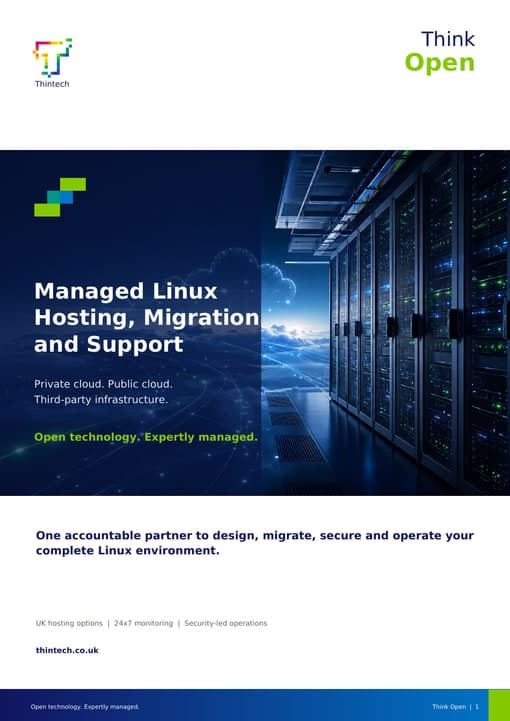
Six-page Think Open brochure
The brochure covers live Linux hosting, cPanel and Plesk, open-source applications, security hardening, migration support, responsive assistance and retained expertise. Final scope, service levels and commercial terms are confirmed in a current proposal or statement of work.
Download the Think Open brochurePDF, 6 pages, approximately 2.7 MB. Service levels and inclusions remain subject to the agreed schedule.Questions before we take responsibility
Think Open is Thintech's managed Linux hosting, migration and support service. It brings design, migration, infrastructure, Linux administration, security controls, monitoring, backup oversight, documentation and support into one agreed operating model.
It can be either or both. Thintech can provide an agreed hosting platform, manage Linux services on infrastructure supplied by another provider, deliver a migration project and then operate the resulting environment. The proposal states exactly which responsibilities apply.
Yes, where discovery confirms suitable platform access, technical compatibility, supplier cooperation and a workable responsibility boundary. Thintech can act as the customer-facing operating partner while coordinating the underlying provider within the agreed scope.
Think Open is intended for supported enterprise platforms including Ubuntu, Red Hat Enterprise Linux, AlmaLinux, Rocky Linux and Debian, plus CentOS migration. Exact versions and other distributions require assessment before Thintech confirms support.
Yes, subject to discovery and an agreed project. Thintech assesses applications, runtimes, databases, control panels, libraries, integrations and recovery needs before recommending the target distribution and migration sequence.
Those can be considered alongside Red Hat Enterprise Linux, Ubuntu or another supported target. The correct choice depends on application and control-panel compatibility, vendor support, lifecycle, operational requirements and customer preference.
Thintech can support agreed Ubuntu and Red Hat Enterprise Linux workloads, subject to supported versions, licensing or subscriptions, application compatibility, access and the activities included in the service schedule.
cPanel, WHM and Plesk assessment, migration and administration can be included where Thintech confirms the version, licensing, target platform, application estate and responsibility boundary. Application-code remediation is separate unless expressly scoped.
Thintech can offer UK hosting and private-cloud options. Data location, facility, infrastructure, resilience, backup, connectivity and service commitments are confirmed in the customer design and contract rather than assumed from this page.
Public-cloud management can be considered, but Thintech confirms current platform capability, access, supported services, tooling and responsibility after discovery. No provider or service is universally included by this page.
24x7 monitoring can be included for agreed production assets. Monitoring scope, signals, alert handling, priorities, response path and customer responsibilities are documented in the service schedule.
Not automatically. Monitoring, alert acknowledgement, investigation, engineering response, remediation and resolution are separate commitments. The selected service defines what Thintech is authorised and resourced to do after an alert.
Agreed critical-incident response can be included for contracted services and priorities. It does not imply immediate support for an unknown environment or guaranteed resolution, and non-contracted enquiries follow the normal scoping route.
Operating-system and infrastructure management does not automatically include application functionality, source code, defects, releases or vendor support. Application-platform administration and troubleshooting can be included where responsibilities are explicit.
Major PHP upgrade, compatibility remediation, framework change and application redevelopment are project work unless a current service schedule expressly includes a defined activity. This protects both parties from treating material transformation as routine support.
Thintech can assess the platform, runtime and dependencies, build target environments and coordinate migration and testing. Changes to source code, frameworks or application behaviour require an agreed application owner or separately scoped remediation capability.
Database-platform administration, monitoring, backup and resilience can be considered where the platform and responsibility are supported and expressly included. Data ownership, application behaviour, specialist tuning and vendor responsibilities remain defined separately.
DDoS-protected connectivity or mitigation options can be designed through approved infrastructure providers. Coverage, limitations, escalation and commercial terms depend on the selected service and provider.
Think Open can use named access, least privilege, controlled key ownership, logging, review and MFA or privileged-access controls where technically supported. The final access model reflects customer policy and the platforms in scope.
Restore testing can be included at an agreed frequency and scope. Backup monitoring alone cannot guarantee that every restore or complete application recovery will succeed; customer and application-owner validation may also be required.
Yes, as separately agreed design and delivery work. Recovery objectives, application architecture, data consistency, provider capability, testing and budget must be understood before a solution or commitment is made.
Duration depends on estate size, documentation, dependencies, compatibility, data, application remediation, provider lead times, testing, maintenance windows and customer acceptance. Thintech produces a plan after discovery instead of publishing a universal duration.
Thintech does not promise zero downtime without evidence and an agreed design. Parallel running, synchronisation and phased cutover can reduce disruption, but each application's consistency, DNS, integrations and acceptance requirements determine the achievable approach.
Thintech records the dependency and presents options such as a different supported target, an isolated runtime, phased remediation, a temporary control with explicit risk acceptance or a separate application work package. The customer approves the chosen route.
Yes, where the provider can supply the required access, support boundary, infrastructure and cooperation. Think Open is not dependent on moving every workload to Thintech hosting.
Think Response provides defined specialist technical support. Think Open adds a Linux-specific hosting, migration and managed-operations model with continuing responsibility for the services and activities agreed in the service schedule.
Think Integrated can operate the wider customer IT environment. Think Open is the focused Linux and open-source infrastructure capability and can sit within, alongside or separately from that broader managed service.
Onboarding can include service discovery, inventory, dependency and risk review, access configuration, monitoring, backup validation, documentation, escalation testing and formal service acceptance. Depth and timescale depend on the estate and agreed service.
Ready to take control of your Linux estate?
Whether you are replacing an unsupported CentOS platform, moving away from unmanaged hosting or looking for one partner to operate business-critical Linux, the first step is to understand the estate and the responsibility you need.
Trusted for regulated environments
Built for mid-market organisations where governance, resilience and accountable delivery matter.